

Reconciling Faith, Ambition, and Your Midlife Money Goals
Are you a woman of faith who sometimes feels a disconnect between your spiritual life and your worldly ambitions? Imagine a system of Christian goal setting for women that is deeply rooted in your Christian faith.
That’s the premise of Rick Seymour’s “God in Your Goals: Reconciling your spiritual journey with success ‘in the world’,” a book I recently revisited during this reflective season leading up to Easter. Its powerful message explores how our spiritual well-being can deeply connect with our ambitions.
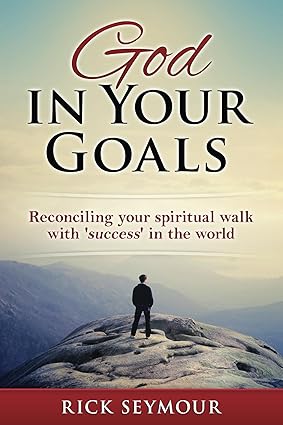
My connection to Rick Seymour goes beyond just this book. I’ve been a long-time admirer of his motivating talks and have personally benefited from the high-quality supplements he offers through Shaklee – particularly their Stress Relief and MindWorks formulas, which have made a noticeable difference in my ability to navigate the daily pressures of life with greater calm and mental clarity.
So, when he announced the release of “God in Your Goals,” I eagerly purchased it, knowing his insights are always grounded in both practical wisdom and a strong faith. If you’re curious about the supplements I trust, you can learn more here.
The Tension We Feel: Faith and Worldly Goals
Seymour’s inspiration for writing this book resonated deeply with me, and I think it will with you, too, as he witnesses the power of positive thinking, affirmations, and visualization—tools you’ve likely encountered in our personal and professional journeys. However, his discernment led him to question these practices due to their association with New Age and humanist philosophies. What does the Bible say, he wondered? Turns out much of what is taught in the realm of personal achievement actually has strong roots in biblical teachings. He remembered a powerful truth: what God intends for good, Satan often perverts.
A Biblical Foundation for Achievement
Because of his research, Seymour is able to seamlessly weave scripture into his guidance. For each point he makes, he offers relevant Bible verses to support his ideas.
He even provides verses for further study and meditation, encouraging us to cultivate a positive mindset grounded in God’s word.
Seymour firmly asserts that God’s sovereignty isn’t a license for passivity. Instead, he emphasizes the importance of communing with God for direction, believing we are called to be marketplace ministers, advancing His kingdom in our everyday lives – whether in our careers, volunteer work, or within our families.
Seymour argues that the foundation of truly effective goal-setting begins with seeking God’s Kingdom first. This resonated deeply with me because, as women, we often face unique societal pressures that discourage our ambitions.

The Inside-Out Approach to Balance
Seymour astutely points out our inclination to chase material “stuff” while neglecting the vital spiritual (our relationship with God) and emotional (our relationships with others) dimensions. True balance, he argues, is an “inside-out job,” beautifully illustrated by concentric circles with a right relationship with God at the center.
He claims this balance is unattainable solely through our own efforts. I wholeheartedly agree. With God at the core, this centeredness allows us to foster healthy relationships with others, ultimately allowing us to appreciate our material blessings without them becoming our primary focus.
As a woman, I observe how so many of us have a hard time with this balance. We are expected to have perfect homes and families. Without God at the core, the pursuit of these external achievements as our highest goal can often feel ultimately unfulfilling.
Bridging the Conscious and Subconscious
Seymour delves into the fascinating interplay between our conscious actions and the programming of our subconscious mind. Drawing on principles of psychology and his extensive background in sales and training, he presents a distinct, step-by-step system designed to bridge this gap and align our inner programming with our conscious behavior. This isn’t just another self-help guide; it’s a carefully constructed methodology.
Practical Tools for God-Centered Goals
Three key takeaways particularly resonated with me. First, while acknowledging the familiar framework of SMART goals, Seymour adds a crucial layer: proactive obstacle planning.
He encourages us to anticipate challenges and visualize our responses, equipping us to navigate setbacks with greater resilience and preventing us from being derailed when life inevitably throws curveballs.
Another practical tool Seymour introduces is the concept of “triggers” – simple “if/when…then…” statements that link our goals to existing routines.
This strategy enhances follow-through by creating clear, actionable steps tied to our daily lives. For example, his suggestion to “when I get dressed, then I will write three follow-up emails” provides a concrete and easily remembered action.
The Power of “Afformations”
Perhaps the most innovative concept Seymour presents is that of ‘afformations,’ a powerful alternative to traditional affirmations. Let’s be honest: Many of us find outlandish affirmations a bit…silly. (Ones like”I am manifesting my luxury car right now.”)
It’s the perversion of the gospel into a “name it and claim it” theology that positions God as a cosmic vending machine. These types of affirmations often feel disconnected from our current reality and usually tap into a generic “universe” rather than the one true God.

That being said, I do believe that traditional affirmations have their place, especially for women. We often grapple with immense self-pressure and persistent negative self-talk, and having tools to combat that inner critic is crucial.
Affirmations rooted in truth and self-compassion, such as “I am strong,” “I am a beloved child of God,” or other statements that remind us of our inherent worth and inner strength, can be incredibly powerful in shifting our mindset and reinforcing our identity in Christ.
For those areas of our lives we want to change, Seymour introduces ‘afformations’ – empowering questions designed to shift our focus and engage our minds in problem-solving.
Instead of stating, “I am wealthy,” he suggests asking, “Why are my finances improving every month?” This subtle shift is profound. Suddenly, our minds aren’t trying to swallow a blatant untruth; they’re actively seeking evidence and solutions.
For me, asking “Why are my finances improving every month?” immediately brings to mind the intentional steps I’m taking: diligently paying down debt, building my emergency fund for security, and actively budgeting to gain control of my spending. It’s a breakthrough for aligning our thoughts with positive action rooted in reality.
Conclusion: Finding Fulfillment in Faith-Driven Ambition
For many of us in midlife, managing our finances wisely becomes increasingly important, whether we’re planning for retirement, supporting children, or simply seeking greater financial peace. The principles in this book can offer a valuable lens through which to examine our midlife money decisions.
As midlife women, we often juggle so many roles and responsibilities. This book offers such a refreshing perspective – that our ambitions and our spiritual journey don’t have to be separate entities.
Seymour’s message isn’t about ignoring practicalities, but about grounding them in a spiritual foundation. “God in Your Goals” prompts us to consider: are our financial goals driven by a desire for security and generosity, reflecting God’s provision, or are they fueled by anxiety and comparison? By integrating our faith into our goal-setting, we can find a deeper sense of purpose and fulfillment.
This Easter season, as we celebrate new beginnings and the power of faith, consider how your spiritual journey can inform and enrich your personal goals. “God in Your Goals” offers a thoughtful and practical framework for doing just that.
It’s a reminder that our aspirations, when rooted in faith and aligned with our values, can be a powerful way to live a life that is both successful and deeply meaningful.
Have you ever considered how your faith impacts your goals? I’d love to hear your thoughts.